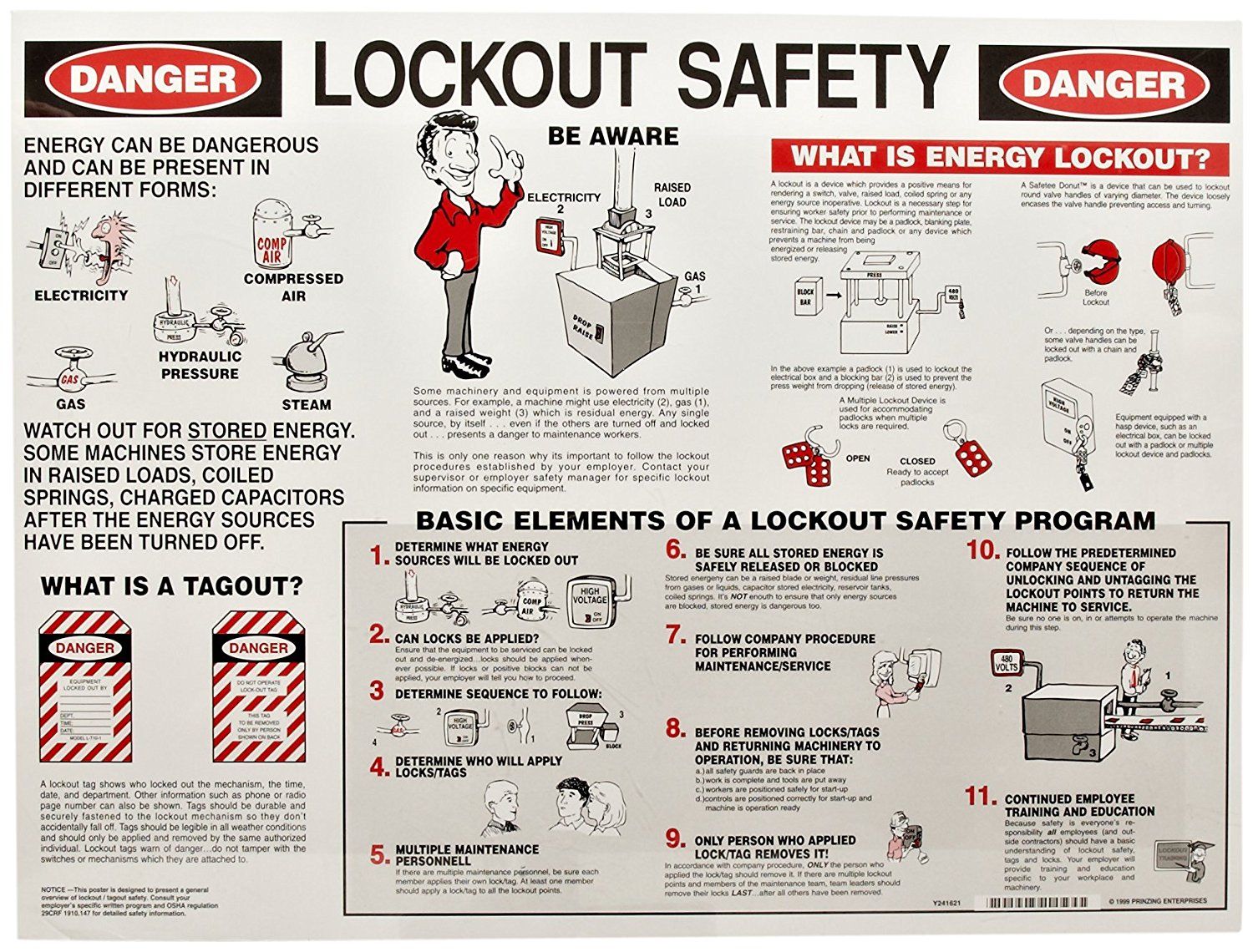
Every year, preventable accidents occur during equipment servicing—workers injured or killed because hazardous energy wasn't properly controlled. The solution isn't complex engineering, but a disciplined adherence to OSHA lockout tagout procedures. These protocols exist for one purpose: to ensure machines are completely shut off and cannot restart before maintenance or servicing is complete.
Despite clear regulations, missteps are common. Workers bypass locks, use generic tags without specificity, or assume a machine is safe when it isn’t. This guide breaks down OSHA's lockout tagout (LOTO) procedures in practical terms—what they require, how to implement them correctly, and where most organizations fail.
What Are OSHA Lockout Tagout Procedures?
OSHA’s lockout tagout standards (found in 29 CFR 1910.147) mandate the control of hazardous energy during servicing and maintenance of machines and equipment. These procedures are designed to protect employees from unexpected energization, startup, or the release of stored energy.
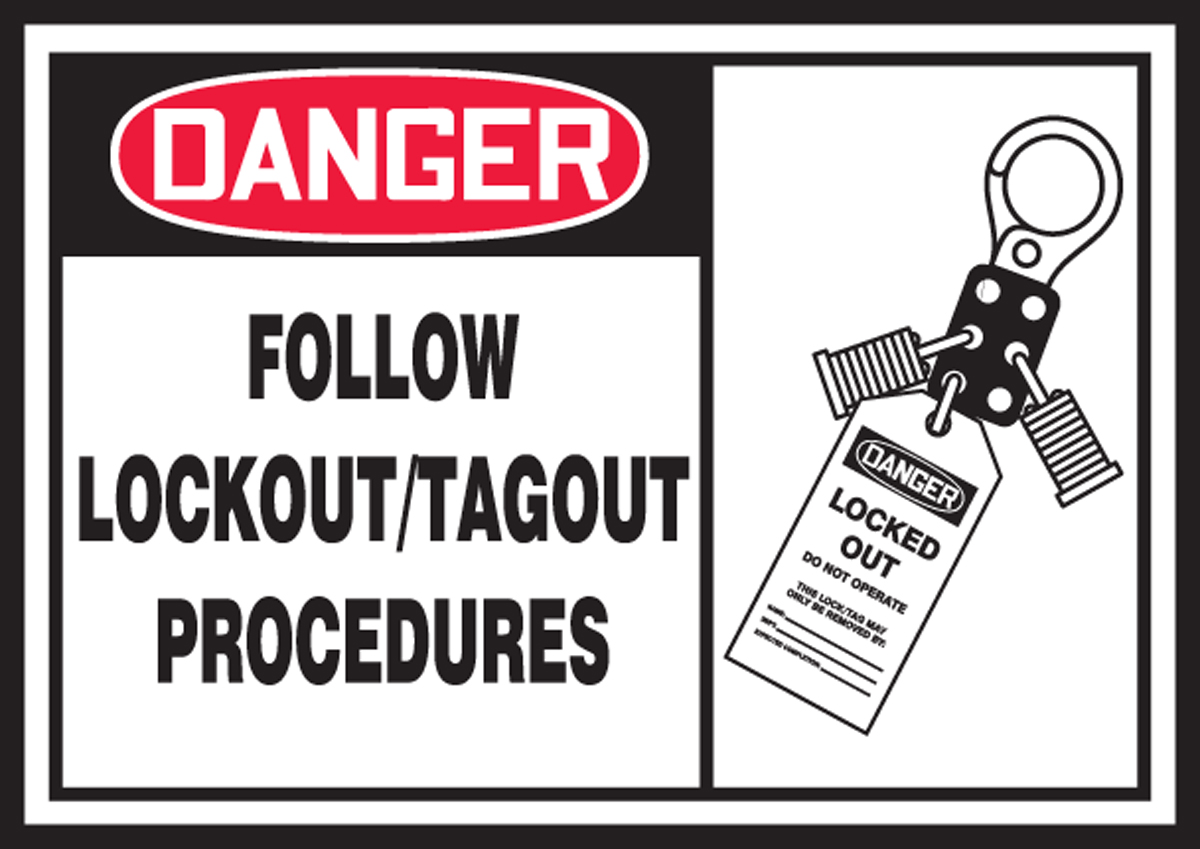
"Lockout" refers to physically locking energy-isolating devices—like circuit breakers or valve handles—so they cannot be turned on. "Tagout" involves placing warning tags on the same devices, indicating that equipment is not to be operated. While both are used together, lockout is the preferred method because it provides a physical barrier.
These procedures apply to any workplace where employees service or maintain machines that could unexpectedly activate, including manufacturing, food processing, HVAC, and utilities.
When Are Lockout Tagout Procedures Required?
OSHA requires LOTO procedures whenever workers perform servicing or maintenance that requires them to:
- Remove or bypass machine guards
- Place any part of the body into a point of operation
- Reach into an area where unexpected movement could occur
Routine production tasks like minor adjustments or lubrication may be exempt if they are routine, repetitive, and integral to production—but only if alternative protective measures are in place under OSHA’s minor servicing exception (29 CFR 1910.147(a)(2)(ii)).
Real-World Example: Conveyor System Cleaning
A worker is assigned to unclog a jammed conveyor belt in a packaging facility. The belt is off, but the motor could still engage if someone hits the start button. Without LOTO, the risk of amputation or crushing is real.
- Proper procedure:
- Shut down the conveyor at the control panel.
- Locate and isolate the energy source (disconnect switch or circuit breaker).
- Apply a personal lock and tag to the disconnect.
- Attempt to restart (verify zero energy).
- Perform cleaning.
- Remove lockout only after the area is clear.
Skipping any step—especially verification—creates a hazard.
The 6-Step OSHA Lockout Tagout Process
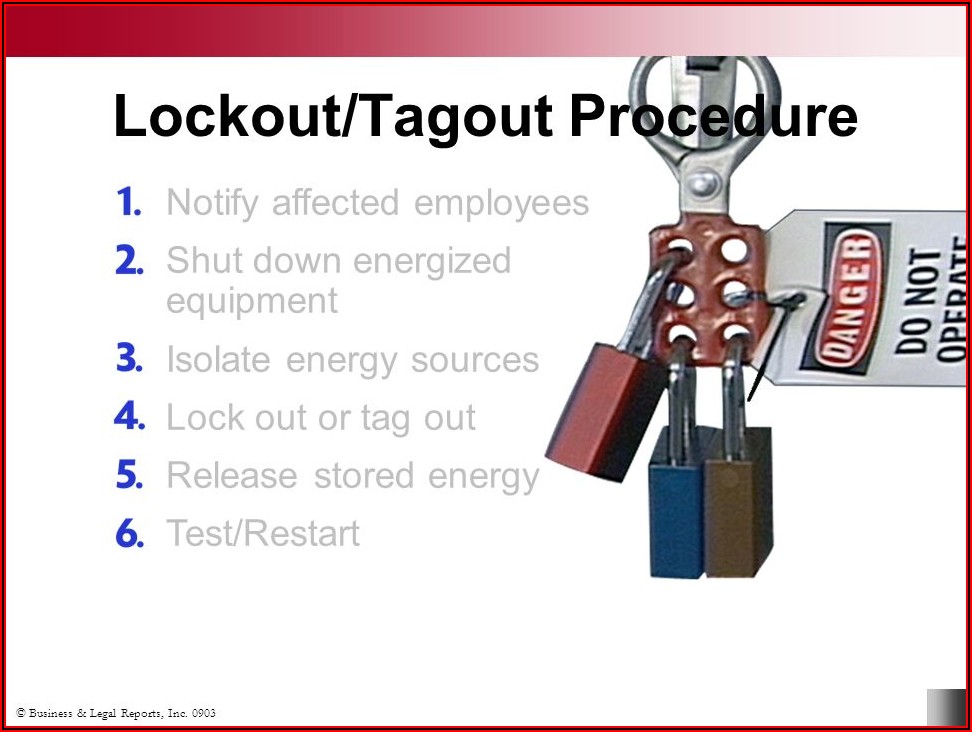
Following a standardized sequence is critical. OSHA doesn’t prescribe an exact number of steps, but compliance best practices organize the process into six clear actions.
1. Prepare for Shutdown
Before shutting down equipment, authorized employees must know: - The type and magnitude of energy involved - The methods to isolate and control that energy - Which lockout devices are needed
This requires up-to-date energy control procedures specific to each machine.
2. Notify Affected Employees
Workers who operate or use the equipment must be informed that servicing is about to begin and that the machine will be shut down. This prevents someone from trying to restart equipment unknowingly.
3. Shut Down the Equipment
Use normal stopping procedures—press the stop button, close valves, etc. Never assume shutdown means "safe."
4. Isolate the Energy Source
Physically disconnect the machine from its energy supply: - Turn off circuit breakers - Close line valves - Block moving parts - Drain residual pressure
This is where most violations occur—failure to isolate all energy sources, including hydraulic, pneumatic, chemical, or gravitational.
5. Apply Locks and Tags
Each authorized employee applies their own lock and tag. Group lockout boxes are used when multiple workers are involved, with each person placing their lock on the box. The key principle: one person, one lock, one key.
Tags must include: - The name of the employee who applied it - Date and time - Reason for the lockout
Tags alone are not sufficient for full compliance unless the employer can prove tagout provides equivalent protection to lockout (rare in practice).
6. Verify Zero Energy
This is the most overlooked step. After locking and tagging, attempt to start the machine using normal controls. Do not bypass safety interlocks. If the machine doesn’t start, verify energy is isolated. Then, check for stored energy (e.g., capacitors, springs, elevated parts).
Only after verification should maintenance begin.
Common Mistakes That Violate OSHA LOTO Standards
Even facilities with written procedures fail in execution. Here are the most frequent errors:
❌ Using a Master Key to Remove Locks OSHA prohibits removing a lock without the employee present unless a formal, documented procedure exists—including notification, verification the worker is not present, and use of a designated safety officer.
❌ Generic or Missing Tags A tag that says “Do Not Operate” without the worker’s name, date, or reason fails OSHA inspection. Specificity saves lives.
❌ Skipping Energy Verification Assuming a machine is off because it’s unplugged or the switch is off is not enough. Always test.
❌ Failing to Train Employees OSHA requires annual training for both authorized employees (those performing LOTO) and affected employees (those operating equipment). Training must be documented and role-specific.
❌ No Machine-Specific Procedures A one-size-fits-all LOTO policy doesn’t comply. Each piece of equipment must have a detailed energy control procedure.
Creating Effective LOTO Procedures: A Workflow Guide
A compliant LOTO program isn’t a binder on a shelf—it’s a living system. Here’s how to build one that works.
Step 1: Conduct an Energy Audit Walk through the facility and identify all equipment that requires LOTO. For each, document: - Energy types (electrical, mechanical, hydraulic, etc.) - Isolation points (disconnects, valves) - Stored energy risks - Required lockout devices
Step 2: Develop Machine-Specific Procedures For each machine, create a step-by-step LOTO procedure, including: - Sequence of shutdown - Location of energy isolation points - Type of lockout device - Verification method
Use photos, diagrams, or QR codes at the machine location to make it accessible.
Step 3: Procure Lockout Devices Use high-quality, standardized equipment:
- Lockout hasps and brackets
- Padlocks with unique keys
- Valve locks, circuit breaker locks, plug locks
- Tagout tags with durable printing
Color-coding by department or energy type improves recognition.
Step 4: Train and Certify Employees Training must include:
- Difference between authorized and affected employees
- Hands-on practice applying locks and tags
- Recognition of hazardous energy sources
- Emergency response if lockout fails
Document all sessions and retrain annually or after incidents.
Step 5: Audit and Inspect Conduct periodic inspections—at least annually—where a supervisor observes a full LOTO cycle and verifies compliance. Use checklists and correct deficiencies immediately.
LOTO Devices and Tools: What You Actually Need
While OSHA doesn’t endorse specific products, using reliable, standardized tools improves consistency and safety. Here are five widely used, OSHA-compliant lockout solutions:
| Product | Use Case | Key Features |
|---|---|---|
| Brady PADLOCK2 | Individual worker locks | Weather-resistant, 100+ key codes, durable steel body |
| Master Lock 140MLA | Circuit breaker lockout | Adjustable jaws fit most breakers, accepts up to 4 padlocks |
| Grace Industries GOVALVE | Ball valve lockout | Fits multiple valve sizes, UV-resistant polymer |
| Honeywell SPCLOTHAG | Lockout hasp | Allows group lockout, corrosion-resistant, 1" shackle |
| Seton 781600 | Universal tagout tag | Pre-printed fields, tamper-resistant, 10-pack |
These tools are not optional extras—they’re part of the engineering controls that make LOTO reliable.
The Cost of Non-Compliance: Fines, Downtime, Tragedy
Failing to follow OSHA lockout tagout procedures carries real consequences.
In 2023, a Pennsylvania food processor was fined over $200,000 after an employee lost an arm when a mixer restarted during cleaning—no lockout was used. The machine had no written LOTO procedure.
OSHA penalties can exceed $16,000 per violation, with willful or repeated offenses reaching $161,000. But the financial cost pales next to worker injury or death.
More subtly, poor LOTO practices erode safety culture. Workers begin to see rules as suggestions, increasing risk across the facility.
Closing: Make LOTO a Habit, Not a Checklist
OSHA lockout tagout procedures aren’t bureaucratic hurdles—they’re proven safeguards rooted in decades of incident data. The best programs don’t just comply; they build a culture where every worker knows that no task is so urgent that safety can be skipped.
Start by auditing one machine today. Write its LOTO procedure. Train one team. Verify isolation yourself. Repeat.
Safety isn’t a policy. It’s a practice. And in energy control, the smallest lapse can be the last.
Frequently Asked Questions
What is the difference between lockout and tagout? Lockout uses physical locks to prevent energy release, while tagout uses warning tags. Lockout is required when feasible; tagout alone is only allowed if it provides equivalent protection.
Who is responsible for implementing LOTO procedures? Authorized employees—those trained to apply locks and tags—are responsible. Employers must provide training, equipment, and written procedures.
Can multiple workers use the same lock? No. Each worker must apply their own lock. Group lockout boxes allow multiple locks on one isolation point.
Do LOTO procedures apply to corded equipment? Yes. If a plug is the sole energy source, a lockable plug lock can be used, and the employee must retain control of the lock key.
How often must LOTO procedures be reviewed? At least annually. Additionally, review after any incident, change in equipment, or process modification.
Is training required for all employees? Yes. Authorized employees (performing maintenance) and affected employees (operating equipment) must both receive role-specific training.
Can LOTO be bypassed for quick repairs? Not unless the task qualifies under the minor servicing exception—routine, minor, and performed during normal production with alternative safeguards.
FAQ
What should you look for in OSHA Lockout Tagout Procedures: A Practical Guide for Compliance? Focus on relevance, practical value, and how well the solution matches real user intent.
Is OSHA Lockout Tagout Procedures: A Practical Guide for Compliance suitable for beginners? That depends on the workflow, but a clear step-by-step approach usually makes it easier to start.
How do you compare options around OSHA Lockout Tagout Procedures: A Practical Guide for Compliance? Compare features, trust signals, limitations, pricing, and ease of implementation.
What mistakes should you avoid? Avoid generic choices, weak validation, and decisions based only on marketing claims.
What is the next best step? Shortlist the most relevant options, validate them quickly, and refine from real-world results.